Year-by-Year World Population Estimates: 10,000 B.C. to 2007 A.D.
There are numerous world population estimates out there. These estimates can differ greatly from one to the next and some are more thorough than others.
Finding estimates for the world's population in the past 50 years is easy. Moving further back in time, it becomes more difficult. Determining population estimates is the science of educated guessing and there are few people willing to stick their neck out on those guesses when talking about thousands of years ago.
The most "complete" set of estimates is provided by Atlas of World Population History (1978) and more recently by John Carl Nelson in Historical Atlas of the Eight Billion: World Population History 3000 BCE to 2020 (2014). The authors of Atlas' have broken the number down by region/country and provided estimates from 200 B.C. to 1975 A.D. They do the same for the overall world population and also provide estimates dating back to 10,000 B.C.
Another good set of estimates comes from Population Growth and Land Use (1968). The book doesn't get as detailed for each region/country of the world, but it does provide world population estimates for the years between 14 A.D. and 1900 A.D.
The League of Nations1, the UN2, and the US Census Bureau3 provide nearly complete estimates for each year in the 20th Century.
Certain years in the estimates vary greatly between the different sets. The best example is the 1 A.D. time period. Estimates vary from 170,000,0004 to 300,000,000.5
Again, being accurate about population estimates from 2,000 years ago is impossible, but by taking all sets of estimates, creating an interpolation to fill in the gaps, and averaging all the estimates, we can get a more complete picture provided by the professionals.
The following chart is comprised of 12 sets of estimates. The complete sets along with sources can be found in Appendix: World Population Estimate Sets.
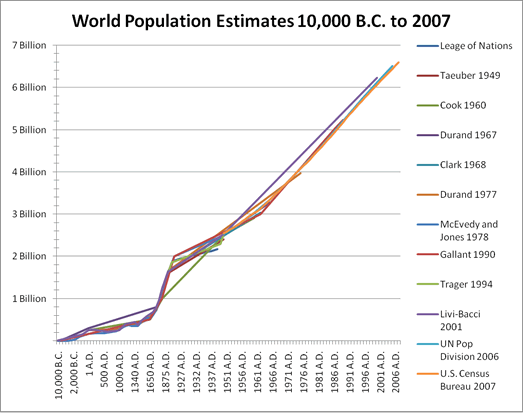
Filling in the Gaps
Finding estimates for milestone years such as 200 B.C., 1 A.D., or 1,000 A.D. is not difficult; it's acquiring an estimate for a random year like 760 A.D. that can drive a researcher to madness.
To fill in the gaps between these estimates, a spreadsheet has been created that lists all available estimates from 10,000 B.C. to 2007 A.D. With each set of estimates starting with the first number available, the missing years have been filled in with an interpolation. For example, if an estimate set gives us estimates for 100 A.D. and 200 A.D., the years 101-199 have been filled in using a growth trend to give a more complete estimate (To see the full list of averaged estimates, see Appendix: World Population Estimates Interpolated and Averaged
).
The simplest example can be seen using Microsoft Excel. In the example below, there are 2 numbers that span across 7 years. The first number is 5 and the final number is 29.

By right-clicking the first cell, dragging the mouse straight down to the final cell, and release the right-click button, a menu is presented. The final menu item "Series" is selected.

This presents the Series pop-up. Under Type, "Growth" is selected. The Trend check box is clicked. After that, click the OK button.

The missing numbers are filled in automatically using a Growth Trend. The numbers provided are then 5, 7, 9, 12, 16, 22, and 29. This is useful when determining the interpolation between two population estimates, because these number increase exponentially (2, 2, 3, 4, 6, 7) which imitates the typical growth in population.

This same method can be used to determine the interpolation between two numbers that are decreasing (e.g. 29 through 5 instead of 5 through 29) to help determine a population decrease.
The Caveats
This method is not without its issues.
First, the obvious: The numbers used are purely estimates. Even though these numbers come from historians, scholars, and departments focused on population studies, they are still simply best guesses. The author of A Concise History of World Population described his estimates as being "largely based on conjectures and inferences drawn from non-quantitative information,"6 which is a fancy way of saying they are educated guesses.
The other caveat is the interpolation will never properly simulate the changes in population. For example, if a population estimate for 100 A.D. is 100,000,000 and for 200 A.D. it is 150,000,000, there is no way to determine what events could have taken place for the population to increase as fast or slow as it did. The population could have reached 160,000,000 in 180 A.D., but due to wars, famine, or plagues, the death rate increased while the birth rate decreased.
We may never have exact estimates for populations in the past, but by using these numbers, we have a more complete consensus from the professionals.
Further Reading
Clark, Colin. Population Growth and Land Use. New York, NY: St Martin's Press, 1968.
Durand, J. "A Long-Range View of World Population Growth." The Annals of The American Academy of Political and Social Science: World Population 369 (1967).
Livi-Bacci, Massimo. A Concise History of World Population. 6th ed. 2017.
McEvedy, Colin and Jones, Richard. Atlas of World Population History. Middlesex, England: Penguin, 1978.
Nelson, John Carl. Historical Atlas of the Eight Billion: World Population History 3000 BCE to 2020. 2014.
Population Division of the Department of Economic and Social Affairs of the United Nations Secretariat, World Population Prospects: The 2006 Revision and World Urbanization Prospects: The 2005 Revision, http://esa.un.org/unpp (accessed April 06, 2007).
U.S. Census Bureau. "Total Midyear Population for the World: 1950-2050." U.S. Census Bureau. http://www.census.gov/ipc/www/idb/worldpop.html (accessed January 10, 2008).
Notes
- The League of Nations provide estimates for the years 1925-1939 throughout 15 of their published yearbooks. Refer to Appendix: World Population Estimate Sets for complete listing. [↩]
- Population Division of the Department of Economic and Social Affairs of the United Nations Secretariat, World Population Prospects: The 2006 Revision and World Urbanization Prospects: The 2005 Revision, http://esa.un.org/unpp (accessed April 06, 2007). [↩]
- U.S. Census Bureau, "Total Midyear Population for the World: 1950-2050," U.S. Census Bureau, http://www.census.gov/ipc/www/idb/worldpop.html. [↩]
- Colin McEvedy and Richard Jones, Atlas of World Population History (Middlesex, England: Penguin, 1978), 342. [↩]
- J. Durand, "A Long-Range View of World Population Growth," The Annals of The American Academy of Political and Social Science: World Population 369 (1967), 2. [↩]
- Massimo Livi-Bacci, A Concise History of World Population, 2nd Ed. (Malden, MA: Blackwell Publishers, 1997), 30. [↩]

Very interesting. I also made my personal estimation of totale number of human beings thru time, coming to a value of 90 billion.
I’m also working on a model for parentality. I may submit if you are interested.
I can’t calculate mid-population, I have figeres for 400 B.C. , 1 A.D., 400 a.d., 800 a.d., 1000 a.d. 1200 1500 1600 1700 1750 1800 1850 1900 1910 1920 1930 1940 1950 1960 1970 1980 1993 2000 2004 2025 a.d, what I have to do?
A commonly-used shortcut is simple interpolation assuming a constant growth rate between the two dates for which you have estimates. But this is a blunt instrument because (1) as noted in the original post, the underlying growth rate tends to rise until its late 20th-century peak, (2) world population is generally assumed to have stagnated or fallen in c.200-600, the 14th-15th centuries and 1620-50 (so that such a method would tend to understate the total around 200 or 1300 and to overstate it in 600 or 1650), and (3) different regions or countries show differing trends. And beware the Americas, for which estimates for 1500 range from 15 to 100 million: take your pick, because by 1650 disease left fewer than 10 million, too few for a reliable back-projection (but few enough in my view to make the highest pre-Columbian estimates deeply suspect). There’s really no substitute for detailed regional or country estimates separated by short intervals, the approach correctly adopted by McEvedy even if some of his results need revision.
Hello David ,
nice to see that you have very interesting approach about the world population, for a personal project , i will like to have some information from you , please help me to have that data base for the calculation
thanks
Carl Haub estimates 106 billion over the past 50,000 years, but this is on the basis of a higher prehistoric and ancient birth rate (8%) and Classical population (300 million at AD 1) than I think likely: my own estimate is 70 billion over 100,000 years. So yours comes reassuringly between the two, and they’re all of the same order of magnitude, and all three agree that many times more have lived than are presently alive.
it be closer to 15 billion as in the last 50 years the population doubled,i also used to think it was a huge number as well,till i looked into it a bit farther.
Pingback:Weekly Blog Post (weekly) | Feed Curiosity
Pingback:Ten Profound Ways The World Will Change In Your Lifetime | E-Scientific News
I’m trying to confirm the validity of the oft-quoted statement that with world population approaching 9 billion by the year 2040, we’ll have to grow as much food in the next 50 years as we have in the past 10,000. Is that statement accurate? (I’d love to use that statement with confidence.) Carmine, your estimate seems to suggest it is. Any chance someone can show me the math?
Thank you!
I’d assumed this was way off the mark, but in fact it seems alarmingly close to reality. Assuming annual food consumption until now to have averaged 500kg of grain equivalent per head (less in ancient times, more in recent centuries), I get around 800 billion tonnes (60bn people averaging say 27 years of life, times half a tonne) over the 10,000-year span. Assuming an annual average of 1,500 kg in the next half century we would have to produce the equivalent of 675bn tonnes (9bn x 50 x 1.5t) over 50 years to offer 9bn consumers a varied diet rich in livestock produce. So it’s not quite there, but it’s of the same order of magnitude, and the statement would be correct if we reduced the earlier period to around 4,000 years. Whether such a burden on the planet’s resources can be sustained is another matter: the elephant in the room is rising livestock output, and the global consumer of the future may have to be less carnivorous than recent populations at similar income levels.
Thanks so much, David!
Pingback:Technological Revolutions That Will Forever Change Our World -
Can we validate hindu mythology or any other religion text by using any population software. Starting from Adam and Eve to the present date how the population has grown.
One can produce results consistent with different traditions or hypotheses for the ancient period, but that isn’t the same as validation, which implies objective support or proof. The data for periods before the last millennium are themselves conjectural, resting on isolated records (mostly for imperial China, and themselves debated as to their implications), archaeological evidence, genetic findings, extrapolation from the wider historical record, and assumptions as to pre-Neolithic carrying capacity, geographical extent and rate of spread of human habitation, and later agricultural expansion. We can’t even validate (or indeed invalidate) any putative population two millennia ago within a range of 50 million or so. Uncertainty as to ancient India’s population is a particular problem, accounting for much of the difference between McEvedy’s 170 million and the commonly-quoted 300m for the world population at 1 CE: such issues make a regional approach potentially more rewarding than global projections.
Hello,
Theoretical
My question is this. What would be the formula I would use to determine the population of a species that can live over 800 years, have no sickness and disease and have abundant supply of food and resources. How would I calculate the population?
It depends on the species. Human numbers can grow at 5% a year in the absence of resource constraints (or even where such constraints apply but plentiful offspring are a necessary investment for support in old age), but people modify their reproductive behaviour according to a range of material and cultural or institutional factors besides health and food or raw material availability, so that prosperous well-fed societies with attractive lifestyle options tend to limit childbearing in favour of other pursuits. So your long-lived population might continue to expand close to its biological limit, or it might limit its offspring to something resembling present numbers.
I know immediately the species of which you speak. The ruling elite, of which the queen of England is one, and they most assuredly ain’t human.
Pingback:10 Profound Ways The World Will Change In Your Lifetime | Viral KittyCat
Pingback:Atmospheric Sciences | What is the biggest air pollution event in the modern era?
Pingback:10 Profound Ways The World Will Change In Your Lifetime - encun
I have calculated Indian population with available data 2015yr-1935yr-1500 yr then proceeded with olden days India’s geographical parts and per family strength and keep it low population 1st AD and growth of 200yrs each excel table up to 2015 and tallying with available population and in formula add 1
( one) each value and get tallied with available population ratio and I got 2million population in 1st AD.
By VP Ganesan -Oct 09, 2015,-19hrs-07min
Pingback:10 Profound Ways The World Will Change In Your Lifetime | Bitcoin Digital Currency Review
Pingback:10 Profound Ways The World Will Change In Your Lifetime - Furniture Brand and Product Reviews
Pingback:10 Profound Ways The World Will Change In Your Lifetime - Computer Store
Pingback:10 Profound Ways The World Will Change In Your Lifetime – edatika
Pingback:10 Profound Ways The World Will Change In Your Lifetime | Your Moms Pants
where can i get an estimate of the world’s population of the year 1916?
What was the population In 8000 bc? I need to know for a project I’m doing in school.
It’s out of syllabus to the human minds…
We only knows the world history of about 2500 years(2500 bc).
Beyond that all are estimations and assumptions.
Question, to anyone who can answer. Why did the population between 1 A.D. and 1500 increase so slowly (or stayed relatively unchanged)? It does not make sense IMO. If we take the normal increases we see generation by generation especially giving the mortality rate of infants and death by other means it tells me that our population was much smaller 2000 years ago. India staying relatively unchanged for 1500 years does not compute. The tradition of all populations until the last century (for some societies only) at the time was large families, if parents had say 12 children and eight survived to have ten children each (again eight surviving) those original two would of increased to 64 withing one generation…and that trend would of continued to the point of those sixty four multiplying to over over 500….two generations have passed again using just eight surviving children and that amount is actually light considering some populations even today could have up to 15 children.
(Using eight kids per generation per person)
2 have 8 surviving kids
8 have 64 surviving kids
64 have 512 surviving kids
512 have 4,096 surviving kids
4096 have 32,768 surviving kids
32,768 have 262,144 surviving kids
262,144 have 2,097,152 surviving kids
2,097,152 have 16,777,216 surviving kids
16,777,216 have 134,217,728 surviving kids
134,217,728 have 1,073,741,824 surviving kids
10 generations and two became a billion. Yes death and plagues and famine would diminish this but look at the results and my estimates aren’t unrealistic….ten generations is as little as 350 years. So why is it that so many sites show between the years of 1 A.D. to 1500 the world population as staying relatively stable when people can produce like this?
I recently built my family tree, on my mothers side alone the amount of people being born and reproducing were huge. My great-great grand parents had 15 kids, his son my great grand father had 12, his daughter my mother had 8 kids….two people, produced so much…and we are still growing….This is going back to the late 1800’s only and there are over one thousand decedents and this was a third world country (El Salvador) not the US. With that said I don’t believe these estimates…even with death, plagues, war and such the population had to increase rapidly….can anyone explain this?
Indians in the new world flourished, China and India would have done the same, even Europe and its warring factions increased with only the plagues holding off growth but after the plagues were over growth started right up.
Can anyone explain this?
that’s just Awesome the you put it “10 generations and two became a billion”
Going by your numbers India and China started out 10 or 15 Generations back
There was virtually no technological or social progress between 1 AD and 1500 AD or so – which is why the countries where people actually live weren’t able to feed a significantly increasing number of people. The progress, which existed in the Greco-Roman world etc., was only restarted with the renaissance etc. around 1500 AD which is when the population restarted the big growth.
Because population can only grow to a size that can be supported by food and other resource production. If there are more people than food to support them, then the excess will die of malnutrition and starvation. Further, that food has to be delivered to the population requiring it, and unprepared food tends to spoil over time.
what was the world population 300 Million years back since Fossil fuels were formed from plants and animals that lived 300 million years back, I’m just curious what it takes to produce so much oil
-Present Day Estimated oil reserves in the world are 1,697,600 million Barrels
-Fossil Fuels take at least 300 million years to produce
algae, no people yo
Yeah, it was plant matter, mostly Algae in the Ocean. What happened was that 300MM years ago, the Earth heated up and there were palm trees in Antartica! Finally, it got so hot that like a stinky green algae pond we’ve all seen, the entire Ocean became a noxic and pretty much everything died in the oceans all at once. From space, the Earth would have been green, not blue during this period. After the oceans died, there was nothing alive, not even bacteria to eat the mostly dead algae and it carbonized into coal and oil. Thus, oil isn’t made from dinosaurs but plants. Also, that was a one time event and once we use it up, its gone. The Earth cooled after that because global warming was essentially stopped because the plants trapped much of the greenhouse gasses. As we continue to burn it up, we are RE-Releasing it into our atmosphere and recreating that same event.
300MM years ago nothing existed that 300 trillion years. Tje univers is only about 16 billion years the Earth only 4.6 billion. 300 M would be before the dinosaurs.
Crude oil is produced by earth itself. Fossil fuels is a misnomer, in my personal opinion. I do not personally believe in crude oils from algae or dinosaurs. Crude oil can be found in comets, as an example. There are vast interstellar clouds of this stuff. Hydrogen and Carbon do combine to form complex organic molecules that we call crude oil under pressure. This then seeps up. I believe there was a major upwelling of such seepage during the carboniferous period, bringing huge amounts of hydrocarbons to the surface creating a boom in life. Just something I sussed from my own sleuthing. Ignore me if this bothers you 🙂
totally agree with you. Crude oil is a product of the earths core. The belief that this carbon derivative is somehow formed from dead reptiles is not only insane and bad science, it is highly irresponsible.
Pingback:10 Profound Ways The World Will Change In Your Lifetime – backcap.org
Pingback:10 Profound Ways The World Will Change In Your Lifetime | Car Auctions - All Makes And Models!
Pingback:“英雄史观”的注脚:宏大科技创新预言的人口增减 – 自媒体圈_全是自媒体
Pingback:10 Profound Ways The World Will Change In Your Lifetime | I Love Train Wrecks
Pingback:Climate change: how did we get here, and why is it so hard to fix? (Part 1) | On Climate Change Policy
Your projected estimates prove that human life did not begin some 200,000 years ago. The planet would be overrun with people. Also, the population growth was not stymied because of a lack of food. There is no evidence of that. People are assuming that. The assumption is either because of lack of food people have less kids, which is not the case now in any part of the world that is in short food supply. Or the assumption is that people died because they starved to death, which means we should find bodies all over the place, which we don’t. Birth rates slow in more technological societies than less. So, the birth rate was probably higher in the past. Given what we do know of birth rates and not what we can speculate, man has probably only been around 6000 years.
A similar thought has not been letting me sleep. If we suppose that the human population was at 1 billion in 1 A.D, that is more than 7 times smaller than it is today just 2000 years ago. By doing the math and using the same ratio, the world population would just be 3-4 people in 20,000 B.C! Keep in mind that we really didn’t reach 1 billion up until the 1800s A.D and the realistic scientific estimates for the world population in 1 A.D max out at just 400 million. Also modern humans supposedly appeared between 1 to 200 thousand years ago. Something just really doesnt add up!
Population doesn’t increase at a linear rate (twice as many every X years) – due to the effects of being better able to keep individual people alive, it can be better modeled as increasing at an exponential rate (for a simplified model, twice as many people in the first X years, then doubling again in X/N years, then X/2N years, then X/3N years, etc). The numbers won’t be as clean as that simple model indicates due to the effects of violence, plague, famine, social collapses, natural disasters, and so forth creating variations in the real rate of increase (and in some cases causing a significant decrease in local populations; it’s been noted that a collapsing society tends to reduce populations in the former society to around 5% of pre-collapse levels due to a combination of factors, though keep in mind that this is a rule of thumb rather than a hard and fast mathematical model).
As to the assertion above that we’d “find bodies everywhere”, I think that commenter is a little too sure of how long human remains will stick around. Even bones tend to disintegrate over extended time periods as they are ground apart by rocks and so on. We’re often lucky to be able to find enough fragments to make a recognizable skeleton – and that’s in dry regions. In moist areas, bones tend to break down into gelatin, except in especially convenient circumstances.
thats assuming which i hate to do btw, that most humans lived and died the way they do today, they dont.
U r true according to world history,religions.
We humans knows the history of world only 2500 years past by the proofs of incidents occurred world wide comparing with time and years….
Beyond that all our calculations are our assumptions.
You are aware of the fact that before we invented writing and recording historical events invention of new things wes extremely slow and the conditions for humans was miserable, right? The evolution of medical science has been slow and only recently have we been able to create PROPER medicine. Keep in mind that leeches were used to cure illnesses in the middle ages. Humans had no way to have the growth rate that we have today because of the conditions and the lack of survivability.
And have you even heard of the industrialization?
The human population spiked extremely fast. The number of humans on the planet exponentially increased in a matter of a few decades and continued it’s growth.
Also, starvation has never been the leading reason of mortality rates. Disease and infections etc have always been a bigger factor worldwide.
Also, even if it was, if there was a problem with food, such as in some parts of Africa, women might have MORE children to assure that one or more of them stay alive and to work as child labour.
All of your arguments are idiotic and I suggest you read a book about human history. You can find then just about everywhere. The bible is not a reliable source.
There is a book about human history… The Bible (KJV of course).
Invention of new things have been slow but that doesn’t make your succeeding assumption correct – ‘conditions for humans was miserable, right?’
WRONG! You may not have had a John Deere to plow your field but you were healthier and happier with the physical labor.
As for leeches, they are still used to treat illness. Look it up.
And maggots were effectual for medical treatment in the Civil War and WWII.
Extrapolate the population backward and you have two people, created by God, who have populated the world. Circa 4004 BC.
What DID NOT happen was a tiny population of monkey-men running around for millions of years. Nor was there a tiny population of ‘modern men’ existing for tens of thousands of years – one catastrophe would have wiped them out at some point,
No. What you have is what the Bible says. A population of 2 from about 4004BC giving rise to a population of about 8 Billion now, just like science would confirm if it were honest. But propagandists have taken over the universities, media and politics. SAD!
I’m related to John Deere.
Yeah for 2 million years before the industrial revolution took place the earth’s population only increased by 3 people… you’ve got a great argument.
Statistical projection has the potential to mislead, projections are nothing but projections. It gives us an idea as opposed to having no idea at all. According to the curve of the graph, it follows that there was a negative population 200,000 years ago 🙂 even in the time of Egypt it looks like there would be only a couple (Adam and Eve?) lol. Surely the slope of the graph is a complete estimate and there have been slow growth and fast growth we cannot know about. One thing is for sure, Malthuse was wrong.
I’m so confused.
Approve.
I guess every one is interested in history. Forget it. Just look forward and see what is the future for humans. if the growth continues in the same rate as it did in the last 300 years, we will have about 1 Trillion people on this earth.
I enjoyed the discussion of world population growth from Neolithic to today. The link to the World Population Estimate Sets seems to be broken. Is there another URL? Thank-you
It should work now. Thank you.
https://docs.google.com/spreadsheets/d/1HhCwxzuF_Cb9R-EhKUq7lG2rZH4bc-pxbxthNFnXEUU/edit?usp=sharing
Pingback:Hey God… Why just the Middle East? – YHWH's Janitor